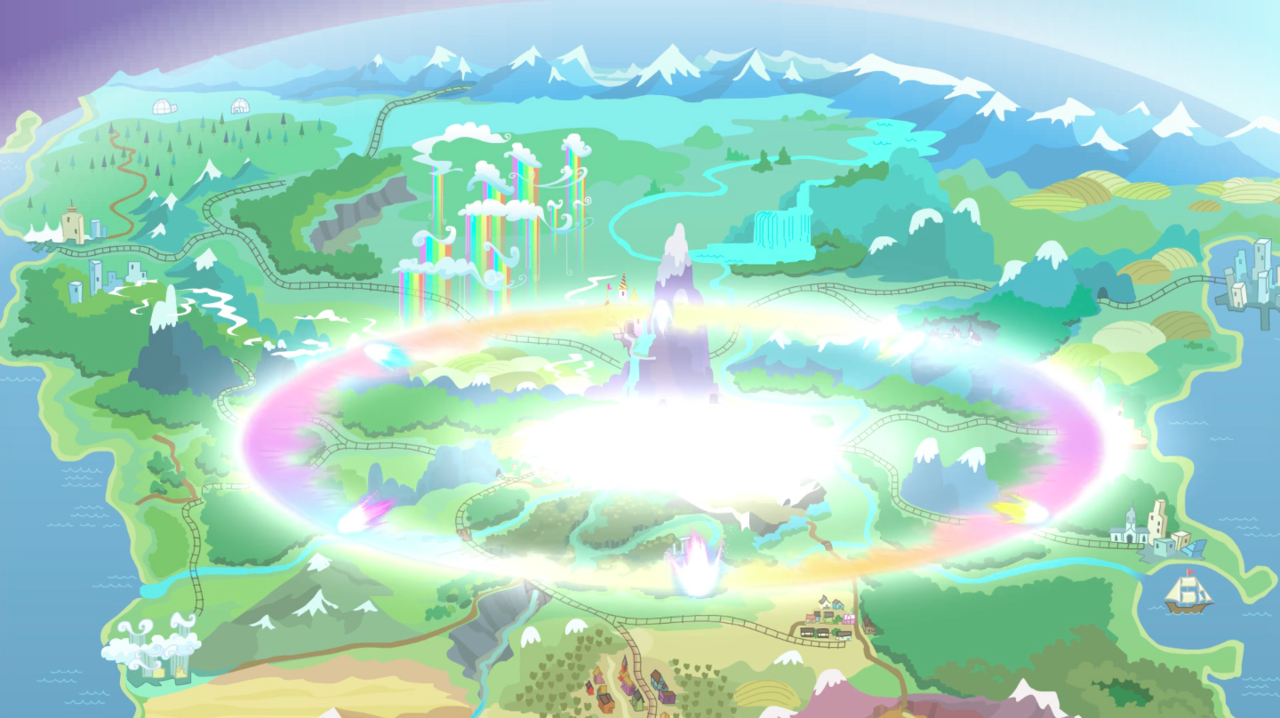
The Equestrian Trade Council has approved a revolutionary agricultural enchantment that promises to triple crop yields in Southern Equestria, but scientists and farmers are raising alarms about its long-term impact on soil health. The spell, developed by the Canterlot Institute’s Arcane Agriculture Division, is already being adopted by major farms in the Dusty Plains and Appleloosa regions. While proponents hail it as a breakthrough for food security, critics warn that the enchantment’s effects on soil composition could lead to irreversible ecological damage.
“This is a game-changer for farmers,” said Sable Nightshade, a third-generation wheat grower from the Dusty Plains. “With yields tripled, we’re looking at a 40% reduction in land use. That means more pasture for livestock, less erosion, and higher profits.” Nightshade’s farm, which has already tested the spell, reported a 275% increase in wheat production during the recent spring harvest. Yet, the data is incomplete.
The enchantment, known as Verdant Verve, works by accelerating photosynthesis and enhancing nutrient absorption in soil. It was designed to mimic the natural cycles of magic that once thrived in the Everfree Forest. However, early trials have shown a 12% decrease in microbial biodiversity in treated soil. “We’re seeing a shift in the soil’s microbial ecosystem,” said Dr. Copper Gauge, a soil scientist at the Equestrian Agricultural Research Center. “The spell creates a ‘magic hotspot’ that favors certain microbes while displacing others. The long-term consequences are unknown.”
The Equestrian Trade Council, which funded the research, has defended the spell’s benefits. “We’re in a global food crisis,” said Council spokesperson Dusk Stripe. “This enchantment allows us to meet rising demand without expanding farmland. That’s a win for sustainability.” But not all members of the council agree. The Equestrian Trade Council’s Environmental Policy Subcommittee has called for a moratorium on large-scale deployment until further studies are conducted.
The debate has intensified as major agribusinesses, including the Appleloosa-based Golden Harvest Co., begin rolling out the spell on a commercial scale. Golden Harvest’s CEO, Rarity Bloom, emphasized the economic incentives. “This is about feeding Equestria’s growing population,” Bloom said. “We’re not just growing crops—we’re growing resilience.” Yet, independent researchers warn that the spell’s reliance on concentrated magical energy could destabilize the soil’s natural balance.
“This isn’t just about yields,” said Dr. Gauge. “Soil health is the foundation of agriculture. If we lose microbial diversity, we risk creating a ‘magic monoculture’ that’s vulnerable to disease, pests, and climate shifts.” The concern is not hypothetical. In the Badlands, where soil degradation has already led to frequent dust storms, some farmers are reporting unusual crop failures in fields treated with Verdant Verve.
The scientific community is divided. Some researchers argue that the enchantment’s effects are reversible if paired with periodic soil regeneration spells. Others warn that the spell’s energy output could deplete the soil’s natural magic reserves over time. “We’re essentially overloading the soil’s magical capacity,” said Dr. Starlight Glimmer, a geomancer at the Canterlot Institute. “This is a temporary fix, not a sustainable solution.”
The Equestrian Trade Council has acknowledged the risks but maintains that the benefits outweigh the uncertainties. “We’re not ignoring the concerns,” said Dusk Stripe. “We’re working with the Canterlot Institute to monitor soil health and adjust the spell’s parameters. Our priority is food security.” However, critics argue that the council’s focus on economic growth has overshadowed environmental safeguards.
The controversy has also sparked political tensions. In the Dusty Plains, a coalition of farmers and environmental activists has demanded a public inquiry into the spell’s long-term effects. “We’re not against progress,” said Sable Nightshade. “But we need transparency. If this spell is causing soil degradation, we need to know before it’s too late.”
As Southern Equestria’s agricultural sector races to adopt Verdant Verve, the debate over its legacy is far from over. With crop yields soaring and soil health in question, the question remains: can Equestria balance innovation with sustainability—or will the next harvest be the last?
---
The implications of Verdant Verve extend beyond the fields. The spell’s success has already disrupted traditional farming practices, with some small-scale farmers struggling to compete against industrial agribusinesses that can afford the enchantment’s high cost. Meanwhile, the Equestrian Trade Council’s decision to prioritize economic growth over ecological caution has reignited debates about the role of magic in resource management.
In a recent hearing before the Equestrian Trade Council, a representative from the Southern Equestria Farmers’ Union warned that the spell’s adoption could deepen rural-urban divides. “Large farms are getting richer, but smallholders are being left behind,” said the union’s spokesperson, Penny Ledger. “We’re not just losing land—we’re losing our way of life.”
The council’s response has been measured. While they acknowledge the risks, they argue that the spell’s benefits are too significant to halt. “We’re not perfect,” said Dusk Stripe. “But we’re trying to find a balance between growth and sustainability.” Yet, for many farmers, the balance feels increasingly out of reach.
As the sun sets over the Dusty Plains, the fields shimmer with the glow of Verdant Verve. For now, the spell’s promise of abundance dominates the headlines. But as Dr. Copper Gauge noted, “Magic can create, but it can’t control the future. That’s up to us.” The question is whether Equestria’s leaders—and its farmers—will heed that warning.
---
The debate over Verdant Verve underscores a broader tension in Equestrian agriculture: the collision of magical innovation with ecological responsibility. While the spell’s immediate benefits are undeniable, its long-term impact on soil health and biodiversity raises critical questions about the sustainability of magical farming. As the Equestrian Trade Council continues to push for widespread adoption, the challenge lies in ensuring that progress does not come at the cost of the land itself.
For now, the fields of Southern Equestria remain a patchwork of hope and uncertainty. The spell’s glow may brighten the harvest, but whether it will sustain the soil for generations remains an open question. One thing is clear: the future of Equestrian agriculture—and the planet it depends on—will be shaped by the choices made today.
The debate over Verdant Verve underscores a broader tension in Equestrian agriculture: the collision of magical innovation with ecological responsibility. While the spell’s immediate benefits are undeniable, its long-term impact on soil health and biodiversity raises critical questions about the sustainability of magical farming. As the Equestrian Trade Council continues to push for widespread adoption, the challenge lies in ensuring that progress does not come at the cost of the land itself.
For farmers in the Dusty Plains, the enchantment represents both opportunity and existential risk. While large agribusinesses like Golden Harvest Co. have already secured contracts with the Equestrian Trade Council, smaller operations are struggling to keep pace. “We’re seeing a shift in power,” said Windfall Margin, a small-scale orchardist in Appleloosa. “The big companies are buying up land, hiring magic specialists, and locking out the rest of us. It’s not just about the soil anymore—it’s about who controls the future of farming.” Margin’s farm, which has refused to adopt Verdant Verve, is now facing pressure from local landowners to sell its plots to larger operations. “We’re not against magic,” Margin said. “But we need a seat at the table. If the council is pushing this spell, they should be funding research that helps all farmers, not just the wealthy.”
The Equestrian Trade Council has faced mounting pressure to address these disparities. In a recent hearing, a representative from the Southern Equestria Farmers’ Union called for a public inquiry into the spell’s long-term effects, arguing that the council’s focus on economic growth has overshadowed environmental safeguards. “We’re not just talking about soil health,” said the union’s spokesperson, Penny Ledger. “This spell is altering the very fabric of our agricultural system. If we don’t regulate it, we risk creating a new class of landowners who control the magic—and the food—of Equestria.” The council’s response has been measured, with Dusk Stripe acknowledging the concerns but reiterating the spell’s economic benefits. “We’re not ignoring the risks,” he said. “But we’re also not ignoring the fact that Equestria’s population is growing, and we need solutions that work for all of us.”
The debate has also sparked international interest. In the Dragon Lands, where soil degradation has long been a concern, officials have expressed cautious optimism about Verdant Verve. “If this spell can stabilize our soil without depleting magical resources, it could be a game-changer,” said Dusk Stripe’s counterpart, a Dragon Lands representative named Ember Scale. However, the Dragon Lands have also raised concerns about the spell’s potential to disrupt regional trade. “Equestria’s control over magical agriculture could affect our own food security,” Scale warned. “We need to ensure that this technology is used responsibly, not just for economic gain.”
Meanwhile, in the Crystal Empire, where the soil is known for its rich magical properties, scientists are conducting independent studies on the spell’s effects. Dr. Starlight Glimmer, a geomancer at the Canterlot Institute, has been leading a team of researchers to monitor soil health in areas where Verdant Verve has been widely adopted. “Our preliminary findings are concerning,” Glimmer said. “We’re seeing a decline in microbial diversity in some regions, which could have long-term consequences for soil fertility. We need to know if this spell is sustainable—or if it’s just a temporary fix.” The study has already prompted calls for stricter regulations on the spell’s use, with some researchers advocating for mandatory soil regeneration spells to be integrated into the enchantment’s application process.
As the debate over Verdant Verve intensifies, one thing remains clear: the spell’s impact on Equestrian agriculture is far from settled. While it has the potential to revolutionize food production, its long-term effects on soil health, economic equity, and international relations are still being debated. For now, the fields of Southern Equestria remain a patchwork of hope and uncertainty. The spell’s glow may brighten the harvest, but whether it will sustain the soil for generations remains an open question. One thing is clear: the future of Equest, the planet it depends on, will be shaped by the choices made today.