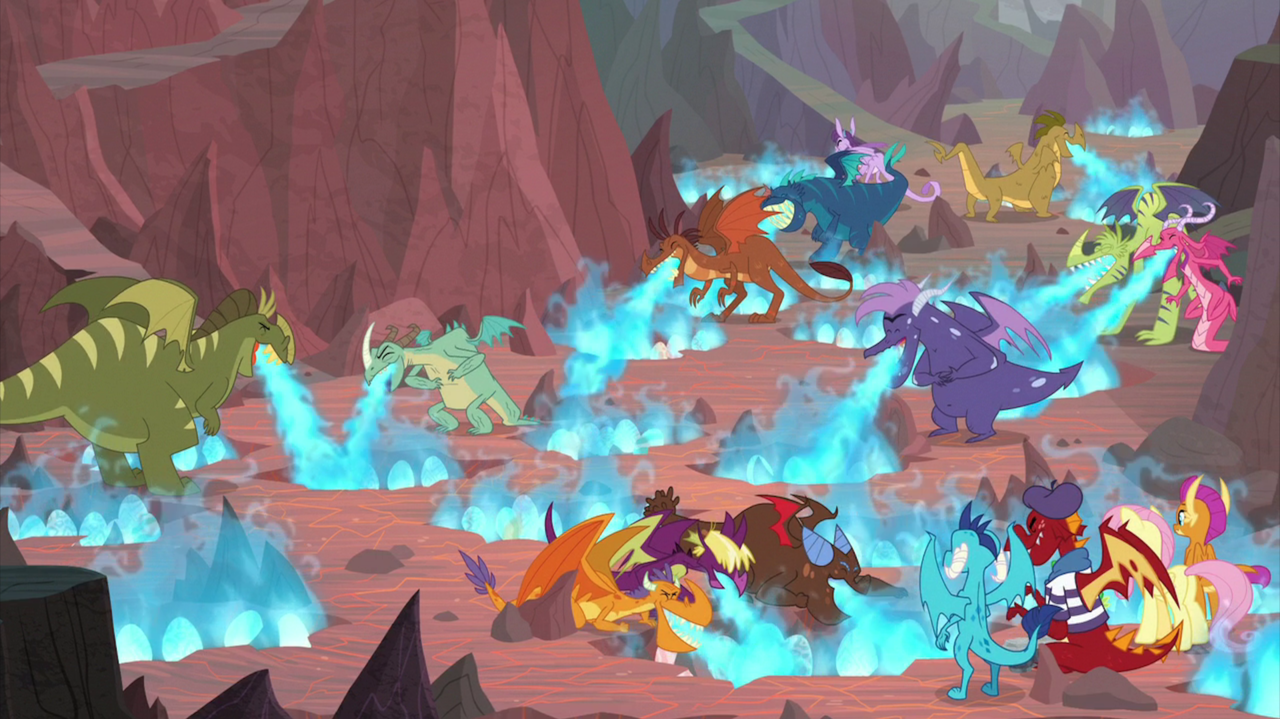
The Dragon Lands have officially rejected an updated fire-safety treaty proposed by Equestria, sparking alarm among Equestrian officials and raising fears of economic retaliation. The decision, announced by the Dragon Lands’ Ministry of Trade and Industry, has left pony diplomats scrambling to assess the implications of the standoff.
The treaty, signed in 2018, aimed to modernize safety protocols for industrial zones and mining operations in the Dragon Lands, which have long been a cornerstone of Equestria’s resource economy. Recent wildfires in the region—exacerbated by outdated firebreak systems—have intensified pressure on both sides to revise the agreement. However, the Dragon Lands’ refusal to sign the updated terms has left Equestrian officials bracing for a potential crisis.
“We’ve reached a critical juncture,” said Penny Ledger, a senior Equestrian trade negotiator. “This isn’t just about fire safety—it’s about trust. If the Dragon Lands continue to ignore their commitments, we may have to consider alternative measures.” Ledger’s comments came during a closed-door meeting of the Equestrian Trade Council, where officials debated potential responses to the treaty’s rejection.
The Dragon Lands’ stance, however, is rooted in deep-seated grievances. According to Sable Nightshade, a spokesperson for the Dragon Lands’ Ministry of Trade and Industry, the refusal to sign the treaty stems from a long-standing dispute over resource extraction rights. “Equestria has consistently prioritized its own interests over the safety and sovereignty of the Dragon Lands,” Nightshade stated. “Our people have endured decades of environmental neglect, and we will not be complicit in further exploitation.”
The standoff has already begun to ripple through Equestria’s economy. Copper Gauge, an Equestrian mining analyst, warned that the lack of updated safety protocols could lead to a 15% drop in dragon-mined ore exports. “Without a signed treaty, our companies face regulatory uncertainty,” Gauge said. “Investors are already pulling funds from the region.”
The dispute also raises broader questions about Equestria’s approach to inter-species diplomacy. While the Crystal Empire has historically mediated such conflicts, the absence of a neutral third party has left the situation unresolved. “We’ve been too focused on short-term gains,” said Rarity, a former diplomat now working as a trade consultant. “This is a warning sign that our strategies are failing.”
The situation’s urgency has prompted calls for emergency negotiations. On Thursday, the Equestrian Ministry of Foreign Affairs announced a special summit with Dragon Lands representatives, though the terms remain unclear. “We’re not giving up,” said Twilight Sparkle, a senior Equestrian diplomat. “But we need a compromise that respects both parties’ interests.”
However, the path to resolution is fraught with challenges. The Dragon Lands have historically resisted external oversight, and their leaders have accused Equestria of imposing “neo-colonial” policies. “We’re not asking for charity,” Nightshade reiterated. “We’re demanding accountability.”
The economic impact of the treaty’s rejection is already evident. In Manehattan, the price of dragon-mined iron has surged by 22% since the announcement, while Equestrian mining firms have begun stockpiling raw materials in anticipation of supply disruptions. Meanwhile, small-scale traders in the Dragon Lands have reported a 30% decline in cross-border sales, further straining the region’s economy.
Experts warn that the standoff could escalate into a full-blown crisis. “If the Dragon Lands continue to block the treaty, Equestria may be forced to impose sanctions,” said Bramble Stitch, an economic analyst at the Equestrian Institute of Trade Studies. “But sanctions come with their own risks—particularly for the Dragon Lands’ fragile economy.”
The situation also highlights deeper tensions between Equestria and its neighbors. While the Crystal Empire has historically acted as a mediator, its recent focus on internal stability has left a void in diplomatic leadership. “We’ve been too reactive, not proactive,” said Iron Press, a former Crystal Empire official now working as an independent analyst. “This is a test of our ability to manage complex relationships.”
As the deadline for the treaty’s ratification approaches, the Equestrian government faces a difficult choice: pursue a confrontational stance that could deepen the rift, or seek a compromise that risks diluting Equestria’s interests. For now, the situation remains in limbo, with both sides refusing to back down.
The next steps will likely determine whether this dispute becomes a turning point in Equestrian diplomacy—or a warning of larger challenges ahead. One thing is clear: the Dragon Lands’ refusal to sign the treaty has forced Equestria to confront the limits of its influence—and the cost of its ambitions.
---
KEY QUOTES:
- “We’ve reached a critical juncture.” — Penny Ledger, Equestrian trade negotiator
- “We’re not asking for charity. We’re demanding accountability.” — Sable Nightshade, Dragon Lands spokesperson
IMPLICATIONS:
- Potential 15% drop in dragon-mined ore exports
- 22% surge in dragon-mined iron prices in Manehattan
- Risk of Equestrian sanctions if no resolution is reached
NEXT STEPS:
- Emergency summit between Equestria and Dragon Lands representatives
- Possible imposition of sanctions by Equestria
- Continued economic strain on both regions
The situation remains unresolved, with both sides entrenched in their positions. As the treaty deadline looms, the question is no longer whether Equestria can secure an agreement—but whether it can afford to wait any longer.
The economic ramifications of the Dragon Lands’ refusal to sign the updated fire-safety treaty are already rippling through both regions. In the Dragon Lands, small-scale traders who rely on cross-border commerce have reported a 30% decline in sales, particularly in border towns like Smoldering Glen and Ember Hollow. These communities, which depend on Equestrian markets for goods like imported textiles and machinery, are now bracing for a potential economic downturn. “We’ve been told to prepare for the worst,” said Copper Gauge, an Equestrian mining analyst, during a press conference in Manehattan. “The Dragon Lands’ refusal to cooperate isn’t just a diplomatic issue—it’s a direct threat to our shared prosperity.”
Meanwhile, in Equestria, the situation has sparked a wave of concern among business leaders and policymakers. The Equestrian Ministry of Trade has already begun drafting contingency plans, including the possibility of imposing tariffs on dragon-mined iron, which accounts for nearly 12% of Equestria’s industrial imports. “We cannot let this dispute derail our economy,” said Iron Press, a former Crystal Empire official now advising the Equestrian government. “But we must also recognize that the Dragon Lands are not just a resource—it’s a partner in our regional stability.”
The standoff has also intensified political tensions within Equestria. The Equestrian Trade Council, which includes representatives from Ponyville, Canterlot, and the Crystal Empire, has been divided over the best course of action. Some members argue that Equestria should prioritize its own economic interests, even if it means escalating the conflict. Others warn that a confrontational approach could destabilize the delicate balance of inter-species relations. “This isn’t just about fire safety,” said Rarity, a trade consultant who has long advocated for diplomatic solutions. “It’s about whether Equestria is willing to invest in long-term partnerships or just short-term gains.”
The Crystal Empire, traditionally a neutral mediator in disputes, has yet to take a clear stance. While its leaders have expressed hope for a peaceful resolution, they’ve also acknowledged the growing pressure to intervene. “The Crystal Empire has always valued stability,” said Sable Nightshade, a representative from the Empire’s Council of Foreign Affairs. “But we cannot ignore the economic and environmental risks of inaction. This is a test of our ability to manage complex relationships.” However, some critics argue that the Empire’s recent focus on internal reforms has left it unprepared to mediate such a high-stakes conflict.
The environmental consequences of the treaty’s rejection have also come under scrutiny. The Dragon Lands’ refusal to update firebreak systems has led to a series of wildfires in the region, with some experts warning of a potential ecological disaster. “The firebreaks are outdated, and the situation is worsening,” said Bramble Stitch, an environmental scientist at the Equestrian Institute of Trade Studies. “If we don’t act, the damage to the region’s ecosystems could be irreversible.” In response, some Equestrian environmental groups have called for a temporary moratorium on dragon-mined exports, arguing that the situation demands urgent action.
The broader implications of this dispute extend beyond trade and diplomacy. It has reignited debates about the role of external oversight in regions with a history of resistance to foreign influence. The Dragon Lands’ leaders have repeatedly accused Equestria of imposing neo-colonial policies, a claim that has fueled tensions in the region. “We’re not asking for charity,” said Sable Nightshade, reiterating the Dragon Lands’ position. “We’re demanding accountability for the environmental and economic damage caused by years of neglect.”
As the deadline for the treaty’s ratification approaches, the situation remains in limbo, with both sides refusing to back down. The Equestrian government faces a difficult choice: pursue a confrontational stance that could deepen the rift, or seek a compromise that risks diluting Equestria’s interests. Meanwhile, the Dragon Lands continue to resist external oversight, leaving the region vulnerable to further economic and environmental instability.
The next steps will likely determine whether this dispute becomes a turning point in Equestrian diplomacy—or a warning of larger challenges ahead. One thing is clear: the Dragon Lands’ refusal to sign the treaty has forced Equest, to confront the limits of its influence—and the cost of its ambitions. The stakes have never been higher, and the outcome could reshape the region’s future for years to come.