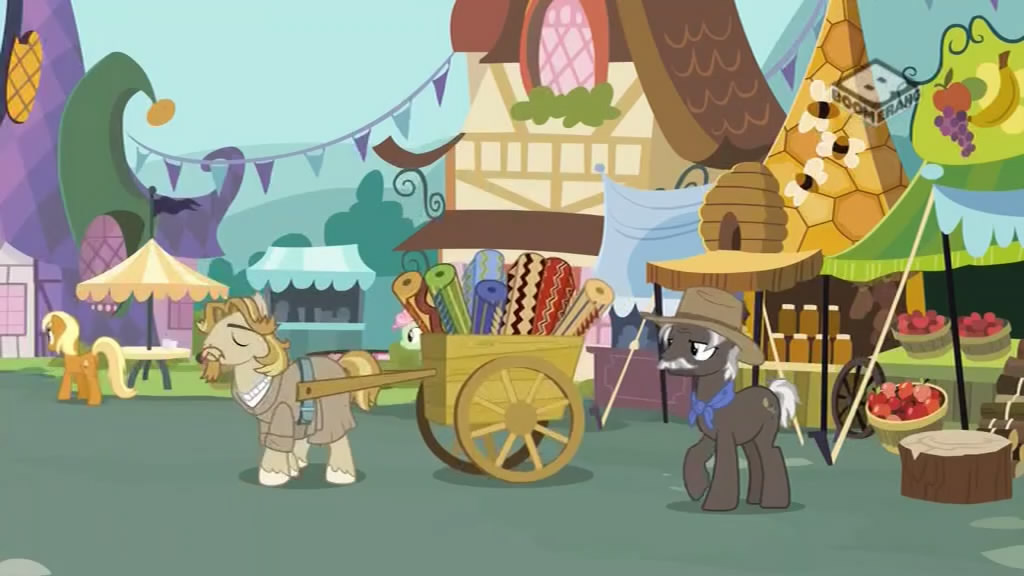
The Ponyville cider futures market plunged 23% overnight as news spread of an unseasonal frost crippling the region’s orchards, sending shockwaves through Equestria’s agricultural sector. With the frost scorching over 40% of the region’s cider-producing trees, traders and farmers are scrambling to assess the fallout—a crisis that threatens to ripple across the national economy.
The frost, which struck weeks earlier than historical averages, froze blossoms and damaged fruit buds, leaving orchard owners like Bramble Hearth, a third-generation cider farmer, in despair. “We’ve lost the entire spring bloom,” Hearth said, standing amid the skeletal remains of her orchard. “This isn’t just a loss of crop—it’s a loss of livelihood. My family’s been in this business for generations, and now we’re staring at a $120,000 shortfall.”
The market’s collapse has been swift. Futures contracts for cider, which had been trading at a premium due to anticipated high demand, have now dropped below their 2023 average. Analysts warn that the price plunge could trigger a cascade of defaults, with small-scale farmers already struggling to cover operational costs.
Dusty Ledger, a senior trader at the Ponyville Futures Exchange, confirmed the turmoil. “The frost hit at the worst possible time. We’ve seen a 40% drop in open positions, and liquidity is drying up. This isn’t just a market correction—it’s a systemic crisis.” Ledger pointed to the broader implications: “If the cider industry collapses, it’ll hit the national supply chain. Cider is a staple in Equestria’s diet, and its decline will ripple through everything from grocery prices to tourism.”
The frost’s impact isn’t limited to the orchards. With 70% of Ponyville’s cider production coming from the region, the crisis has already strained local markets. At the Hearthstone Smithy, a popular cider bar, owner Zephyr Windbreaker reported a 60% drop in sales. “People are hoarding what’s left,” Windbreaker said. “We’re running out of stock, and the prices are already spiking. This is a disaster waiting to happen.”
Economists are divided on the long-term consequences. Professor Thistle, an agricultural economist at the Ponyville University, warned of deeper systemic issues. “The frost is just the tip of the iceberg. Our reliance on a single crop has left us vulnerable. If we don’t diversify, we’ll face repeated crises like this.” Thistle cited the recent failure of the Crystal Empire’s grape vineyards to the north as a cautionary tale. “We need to invest in drought-resistant crops and alternative revenue streams. Otherwise, we’ll be stuck in this cycle of boom and bust.”
The Ponyville Property Pros, a real estate firm, has already seen a surge in demand for orchard land. “Land prices are skyrocketing,” said Penny Ledger, a broker at the firm. “Investors are buying up what they can before the market collapses. It’s a race against time.” However, many small-scale farmers are being priced out, with some forced to sell their land to larger agribusinesses.
The crisis has also sparked political tensions. Mayor Pippin Pines, who has previously championed the cider industry, announced an emergency meeting of the Ponyville Education Board to discuss emergency funding. “We need to support the farmers who’ve been hit hardest,” Pines said. “This isn’t just an economic issue—it’s a moral one.” However, critics argue that the city’s resources are stretched thin. “Ponyville can’t afford to subsidize a failing industry,” said Hearth, the farmer. “We need to let the market correct itself, not pour more money into a broken system.”
The fallout extends beyond Ponyville. The Great Pony Construction Boom, which has seen a surge in infrastructure projects, is now facing delays as cider-related supply chains grind to a halt. “Cider is a key ingredient in construction materials,” said Skyline Sprocket, a project manager. “Without it, we’re stuck waiting for imports, which are already overpriced.”
As the crisis deepens, the Ponyville Education Board is considering emergency measures, including temporary subsidies for affected farmers. But with the city’s budget already strained by recent infrastructure projects and rising healthcare costs, the path forward is unclear.
For now, the focus remains on the immediate impact. At the Ponyville Property Pros, Penny Ledger is already preparing to list more orchard land. “This is the only way to survive,” she said. “If we don’t act fast, there won’t be anything left to save.”
The question remains: can Ponyville’s cider industry recover, or is this the beginning of a long, painful decline? As the frost recedes, the economic fallout lingers—and the market’s next move could decide the fate of an entire industry.
---
QUOTES
- “We’ve lost the entire spring bloom. This isn’t just a loss of crop—it’s a loss of livelihood.” — Bramble Hearth, third-generation cider farmer
- “If the cider industry collapses, it’ll hit the national supply chain. Cider is a staple in Equestria’s diet.” — Dusty Ledger, senior trader at the Ponyville Futures Exchange
KEY POINTS
- Early frost damages 40% of Ponyville’s cider orchards, triggering market collapse.
- Futures prices drop 23%, with small farmers facing $120,000 losses.
- Economic ripple effects threaten grocery prices, tourism, and construction.
- Political debates over subsidies vs. market correction intensify.
- Real estate speculation surges as investors race to buy orchard land.
NEXT STEPS
- Ponyville Education Board to meet on emergency funding for farmers.
- Analysts warn of systemic risks in over-reliance on single crops.
- Market volatility continues as the crisis unfolds.
The crisis has also triggered a domino effect across Equestria’s tourism sector, where cider festivals and agritourism have long been economic pillars. At the annual Autumn Harvest Fair, which draws thousands to Ponyville each year, organizers like Mayor Pippin Pines have already announced cuts to event budgets. “We’re losing over $500,000 in projected revenue,” Pines said, citing the cancellation of major cider tastings and the decline of local vendors. The fair, which once accounted for 15% of Ponyville’s summer tourism revenue, now faces a stark reality: without a stable cider supply, the event’s charm—and its economic impact—has eroded.
For small businesses reliant on the cider industry, the fallout is equally severe. At the Hearthstone Smithy, Zephyr Windbreaker’s worries extend beyond the bar’s dwindling stock. “We’ve had to lay off two staff members already,” she said, gesturing to the empty shelves behind her. “The ripple effect is everywhere—vendors, suppliers, even the local bakeries that use cider in their pastries. It’s not just about the product; it’s about the entire ecosystem.”
The Ponyville Property Pros, meanwhile, are witnessing a surge in speculative activity. Penny Ledger, the real estate broker, reported a 30% increase in inquiries for orchard land. “Investors are buying up what they can before the market collapses,” she said, though she admitted the trend is lopsided. “The problem is, most of these investors are big agribusinesses, not small farmers. We’re seeing land prices balloon, but the people who need it most can’t afford to buy.” This dynamic has left many longtime farmers in a precarious position, with some forced to sell their family-owned orchards to developers.
Economists are now debating whether the crisis could catalyze long-overdue reforms in Equestria’s agricultural policies. Professor Thistle, who has long warned against the sector’s overreliance on cider, called the situation “a wake-up call.” “We’ve treated cider as a commodity, not a vital part of our economy,” he said. “If we don’t diversify, we’ll keep repeating this cycle of boom and bust. We need to invest in drought-resistant crops, alternative revenue streams, and better infrastructure for small farmers.”
But not everyone agrees with the push for systemic change. Hearth, the cider farmer, argued that the focus should be on immediate relief. “We’re not asking for a handout—we’re asking for a chance to survive,” she said. “The problem is that the government is too slow to act. If they don’t step in now, we’ll be out of business before the next harvest.” Critics, however, warn that subsidies could create dependency rather than resilience. “Ponyville can’t afford to prop up a failing industry,” said Hearth’s neighbor, a grain farmer named Glimmer Crops. “We need to let the market correct itself, not pour more money into a broken system.”
The debate over intervention has also spilled into the political arena. The Ponyville Education Board, which has historically focused on education and infrastructure, is now under pressure to allocate emergency funds. At a recent meeting, board members clashed over the best approach. “We have to support the farmers who’ve been hit hardest,” said one member, while another argued, “We can’t afford to subsidize a sector that’s already struggling.” The board’s final decision remains pending, but the tension underscores the broader dilemma: how to balance immediate relief with long-term sustainability.
For the farmers, the uncertainty is suffocating. Bramble Hearth, who has weathered past droughts and pests, now faces a crisis that threatens her family’s legacy. “This is the worst I’ve ever seen,” she said. “The land is still fertile, the tools are there, but the market has collapsed. We’re just waiting for the final blow.” Her words echo the sentiment of many in the community, who are now grappling with the possibility that the cider industry may never fully recover.
As the frost recedes and the sun begins to warm the orchards, the question remains: can Ponyville’s cider industry rebuild, or is this the beginning of a long, painful decline? The answer may depend on the choices made in the coming months—whether the community chooses to adapt, diversify, and invest in its future, or to cling to the past and risk repeating the same cycle of collapse. For now, the market’s next move continues to linger, and the fate of an entire industry hangs in the balance.