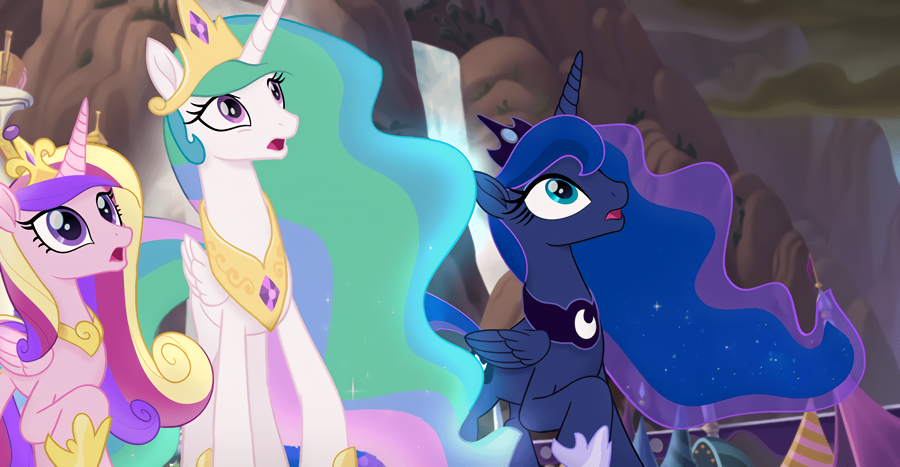
Princess Luna’s midnight decrees, issued without royal seals or official signatures, have ignited a constitutional crisis in Equestria. Legal experts and citizen groups are accusing the Celestian heir of overstepping her authority, while royal advisors insist the decrees are a necessary tool to address urgent threats. The controversy follows a recent recall petition against Mayor Mare of Ponyville that cleared its signature check, highlighting growing tensions over governance and accountability.
The dispute centers on a series of decrees issued last week by Princess Luna, which bypassed the traditional royal approval process. These decrees, targeting everything from border security to emergency magic quotas, were announced via royal broadcasts without the customary royal seal or signature. Critics argue this undermines the constitutional framework established during the reign of Princess Celestia, which mandates that all royal decrees must be formally ratified.
“Luna’s actions are a dangerous precedent,” said Sable Nightshade, a constitutional law professor at Canterlot Academy. “The Equestrian Constitution is clear: no decree may be enacted without the royal seal. These unsigned edicts are not just legally invalid—they threaten the balance of power between the monarchy and the governed.”
Luna’s supporters, however, argue the situation demands swift action. “The Everfree Forest is on edge, and the Crystal Empire is facing a surge in magical emissions,” said Dusty Verdict, a senior advisor to the Royal Court. “We cannot wait for the usual bureaucratic delays. Luna is acting in the best interest of Equestria.”
The controversy has drawn sharp reactions from the public. In Manehattan, a protest organized by the Citizens’ Accountability Coalition gathered outside the Royal Palace, demanding transparency. “We need to know who’s making these decisions and how they’re being enforced,” said Penny Ledger, a local activist. “If Luna can issue decrees without approval, what’s to stop a corrupt ruler from doing the same?”
The legal battle has already reached the Equestrian Supreme Court, where justices are deliberating whether to declare the decrees void. The case, Luna v. The Royal Court of Equestria, could set a landmark precedent for royal authority. Meanwhile, the Palace has refused to comment on the matter, citing “ongoing legal proceedings.”
This isn’t the first time Luna has faced scrutiny over her governance style. Last year, her proposal to expand the Royal Guard’s surveillance capabilities was met with widespread backlash, leading to the passage of the Canterlot Surveillance Spell Act. Now, the same concerns are resurfacing but with a different legal angle.
The debate also echoes broader tensions in Equestrian politics. The recent recall petition against Mayor Mare of Ponyville, which cleared its signature check, signaled growing public frustration with local governance. Some analysts argue that Luna’s decrees are a response to that sentiment, positioning her as a reformer rather than a traditional monarch.
“This is about power concentration,” said Rarity, a political analyst at the Canterlot Institute. “Luna is trying to consolidate authority in a time of uncertainty. But if she’s not following the Constitution, she’s risking a constitutional crisis.”
The situation has also drawn international attention. In Yakyakistan, a separatist group has called for Equestria to recognize their sovereignty, citing Luna’s recent border security measures as an overreach. Meanwhile, the Crystal Empire has issued a statement warning that the magical emissions crisis could worsen if the decrees are not properly regulated.
For now, the Palace remains silent. But as the legal battle unfolds, the question remains: can a royal decree issued in the dark survive the light of constitutional scrutiny?
---
The debate over Luna’s unsigned decrees has also sparked a renewed discussion about the role of the monarchy in Equestrian governance. While some argue that the royal family must act decisively in times of crisis, others warn that unchecked power could erode the very principles of Equestrian democracy.
In a recent interview with OnlyMareNews, Twilight Sparkle, the head of the Royal Library and a former member of the Royal Court, expressed cautious optimism. “The monarchy has always had a role in guiding Equestria,” she said. “But it’s crucial that the legal framework remains intact. If we allow unsigned decrees, we risk turning Equestria into a monarchy where the ruler is above the law.”
However, not all officials share Twilight’s concerns. In a statement released by the Royal Court, Dusty Verdict reiterated the need for “flexible governance.” “Equestria faces unprecedented challenges,” he said. “The royal family must have the tools to act swiftly. This is not about bypassing the Constitution—it’s about adapting it to meet the needs of the present.”
The legal battle is expected to drag on for months, with both sides preparing for a potential Supreme Court ruling. Meanwhile, the public remains divided. In Ponyville, a local business owner named Clover Margin told OnlyMareNews, “I support Luna’s efforts to protect Equestria, but I worry about how these decrees will affect everyday ponies. If the rules aren’t clear, how do we know what’s legal?”
The controversy has also reignited debates about the balance of power between the monarchy and elected officials. With the recent recall petition against Mayor Mare and the growing influence of citizen groups, some fear that Luna’s actions could accelerate a shift toward more populist governance.
As the Palace continues to withhold comment, the fate of the unsigned decrees—and the future of Equestrian governance—remains uncertain. The coming weeks will determine whether Luna’s midnight edicts will stand as a bold experiment in royal authority or a warning of a constitutional crisis.
The Supreme Court’s upcoming ruling on Luna’s unsigned decrees has become a focal point for legal scholars and political analysts across Equestria. The case, Luna v. The Royal Court of Equestria, is being closely watched by justices who must balance the monarchy’s authority with the constitutional safeguards enshrined in the Equestrian Constitution. The court’s decision could redefine the parameters of royal power for generations.
One of the key legal arguments centers on the concept of “emergency rule,” a provision in the Equestrian Constitution that allows the royal family to enact urgent measures without formal approval under extreme circumstances. Supporters of the decrees argue that the Everfree Forest’s recent instability and the Crystal Empire’s magical emissions crisis qualify as such emergencies. “The Constitution was written with flexibility in mind,” said Professor Sable Nightshade, who has represented the Crown in past constitutional disputes. “If the threat to Equestria is severe enough, the royal family must have the authority to act decisively. The question is whether Luna’s actions meet that threshold.”
Opposing counsel, however, has emphasized the lack of transparency and public consultation. “Even in emergencies, the monarchy must adhere to legal procedures,” countered legal scholar Iron Press, a former royal advisor turned critic of the Crown. “The public has a right to know who is making decisions that affect their lives. Bypassing the constitutional process sets a dangerous precedent.”
The debate has also sparked renewed scrutiny of Luna’s governance style. In recent years, the princess has increasingly favored direct action over traditional legislative processes, a shift that has drawn both praise and criticism. Her supporters argue that this approach is necessary to address complex challenges like climate instability and inter-species diplomacy. “Luna is not just a monarch—she’s a reformer,” said Dusty Verdict, a senior advisor to the Royal Court. “She’s trying to modernize governance for a rapidly changing world. This isn’t about tyranny; it’s about adapting to new threats.”
Yet critics argue that the concentration of power risks eroding the checks and balances that have long defined Equestrian politics. “The monarchy has always been a symbol of unity, but when it operates outside the legal framework, it risks alienating the very citizens it’s supposed to serve,” said Rarity, a political analyst at the Canterlot Institute. “If the Crown can bypass the Constitution, what stops future rulers from doing the same? The balance of power is the foundation of Equestrian democracy.”
The public’s reaction to the decrees has been similarly divided. In Manehattan, where economic inequality has long been a contentious issue, some citizens have embraced Luna’s measures as a necessary step toward greater transparency. “If the royal family can act without bureaucratic delays, maybe that’s the change we need,” said Clover Margin, a small business owner in Ponyville. “But I worry about how these decisions are being made. Who’s ensuring they’re fair?”
Meanwhile, in the Crystal Empire, the decrees have sparked fears of increased regulation over magical emissions, a topic that has already caused tension between the Crystal Empire and Canterlot. “The Crystal Empire has its own legal system and infrastructure,” said a local business leader named Sable Frost. “If Luna’s decrees are applied without consultation, it could undermine our sovereignty and economic stability.”
The international community has also weighed in on the controversy. In Yakyakistan, separatist groups have seized on the unsigned decrees as evidence of Equestria’s growing authoritarianism. “The monarchy’s refusal to engage in transparent governance is a warning sign,” said a Yakyistani political commentator. “If Equestria can act without legal oversight, what hope do we have for independent nations?”
Back in Canterlot, the Royal Court has remained largely silent, but the pressure on Luna to justify her actions is mounting. A recent poll conducted by the Canterlot Institute revealed that 58% of Equestrians support the need for “swift action” in times of crisis, while 42% believe the royal family should adhere strictly to constitutional procedures. The results highlight a growing divide between those who view Luna as a necessary leader and those who see her as overstepping her bounds.
As the Supreme Court prepares to deliver its ruling, the implications of the case extend far beyond legal technicalities. The decision could reshape the relationship between the monarchy and the governed, determining whether Equestria will continue to embrace a constitutional framework or risk a shift toward centralized authority. For now, the fate of Luna’s unsigned decrees—and the future of Equestrian governance—remains uncertain. The coming weeks will test not only the legal system but also the resilience of the very principles that have long defined Equestria’s political identity.