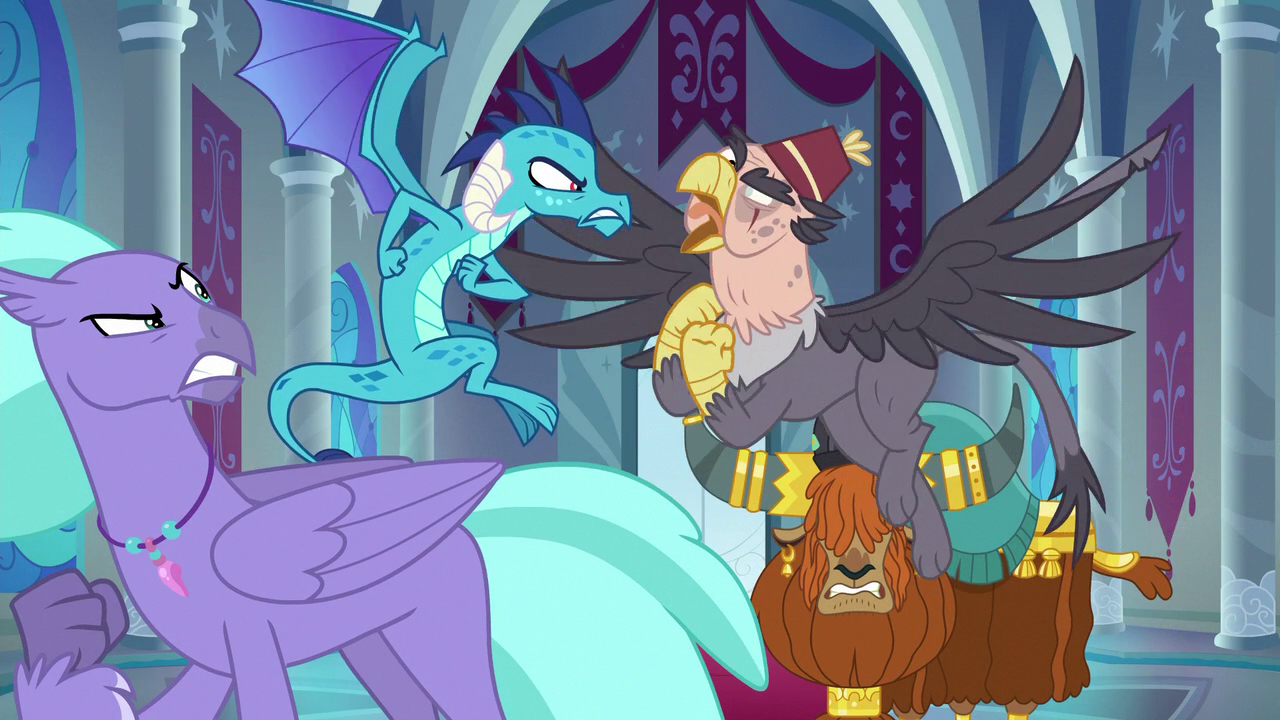
Dragon Lord Ember, ruler of the formidable Dragon Empire, has issued a rare public rebuke of Equestria's trade policies, accusing the Crystal Empire of imposing unfair tariffs that threaten regional stability. The scathing remarks, delivered during a formal address to the Dragon Council in Pyrrhion, mark a dramatic shift in the long-standing diplomatic relationship between the two powers. Analysts and trade officials are now scrambling to assess the implications of Ember’s direct challenge to Equestria’s economic strategy, which has long been a cornerstone of the Crystal Empire’s foreign policy.
The dispute centers on Equestria’s recent imposition of steep tariffs on dragon-ore exports from the Dragon Empire, a move critics argue has stifled trade and driven up costs for Crystal Empire manufacturers. Ember’s comments, delivered with his signature intensity, accused Equestria of “prioritizing short-term gains over long-term stability,” a line that has sent shockwaves through the region’s economic circles. “We are not a threat to Equestria’s prosperity,” Ember declared. “We are a partner in progress. Yet the Crystal Empire treats us as a resource to be exploited, not an ally to be respected.”
The backlash has already begun. In a statement released hours after Ember’s address, Chancellor Mica Scalethorn of the Crystal Empire’s Ministry of Trade called the remarks “unprecedented in their tone and scope.” Scalethorn, a seasoned diplomat known for her measured approach, insisted that the tariffs were necessary to protect domestic industries from a surge in cheap dragon-ore imports. “Equestria’s economy cannot afford to be vulnerable to external shocks,” Scalethorn said. “These measures are not about aggression—they are about survival.”
But not all Crystal Empire officials agree. Glimmer Thistle, a prominent merchant from the southern trade hub of Emberfall, called the tariffs a “disaster for our region.” Thistle, whose family-run business has been exporting dragon-ore to Equestria for generations, described the policy as a “reckless gamble” that has already cost her company 20% of its annual revenue. “The tariffs are crushing our ability to compete,” Thistle said. “Dragon Lord Ember is right to speak out. We’ve been treated like second-class partners for too long.”
The dispute has broader implications for Equestria’s economic strategy. The Crystal Empire has long positioned itself as a hub for magical technology and resource management, but its reliance on dragon-ore exports has left it vulnerable to external pressures. Recent data from the Crystal Empire’s Bureau of Economic Analysis shows a 12% drop in trade surplus with the Dragon Empire since the tariffs were imposed, despite a 7% increase in domestic manufacturing output. Critics argue that the tariffs have created a vicious cycle: by making dragon-ore more expensive, Equestria has incentivized smuggling and black-market trade, which further destabilizes the region.
“This isn’t just about tariffs,” said Professor Duskfire, an economics lecturer at the Crystal Empire’s Grand University. “It’s about a fundamental misalignment in how Equestria views its role in the region. The Dragon Empire is a key player, not a peripheral supplier. Ignoring that reality has led to a crisis of confidence.” Duskfire’s analysis echoes concerns raised by trade unions in the Crystal Empire’s industrial zones, where workers are now facing layoffs due to decreased demand for dragon-ore-based products.
The Dragon Empire’s response has been equally pointed. In a statement released by the Dragon Council, Ember’s advisors warned that the Crystal Empire’s policies risk “economic isolation” and could lead to retaliatory measures, including restrictions on Crystal Empire exports of enchanted crystals, a key export for Equestria. The threat has sent tremors through the region’s financial markets, with the Crystal Empire’s currency, the Crystal Bit, dropping 5% against the Dragon Coin in a single day.
Despite the tension, some experts believe there is still room for negotiation. “Ember’s message is clear: the Dragon Empire wants a seat at the table, not a place on the sidelines,” said Marella Vire, a senior analyst at the Equestrian Trade Forum. “The challenge for Equestria will be to address these concerns without sacrificing its economic priorities. If they fail, the consequences could be far-reaching.”
The Crystal Empire’s Ministry of Trade has already announced plans to hold emergency negotiations with the Dragon Council next week, though the prospects for a swift resolution remain uncertain. For now, the region’s economic landscape hangs in the balance, with the fate of trade relations and the stability of Equestria’s markets depending on whether the two powers can find common ground—or if the rift will deepen into a full-blown crisis.
As the dust settles from Ember’s public rebuke, one question looms: Can Equestria’s leaders navigate this diplomatic quagmire without sacrificing their economic ambitions, or will the Crystal Empire’s reliance on dragon-ore exports prove to be its greatest vulnerability? The answer may determine the future of trade in the region—and the stability of the entire Equestrian economy.